Wednesday, November 18, 2015

The Word Exchange

Douglas Johnson, the brilliant editor of the third edition of the North American Dictionary of the English Language, has disappeared. And so has the about-to-be-released third edition of the dictionary. Even worse, a word flu pandemic is spreading: people are falling ill and their speech is littered with gibberish. So begins this marvellous dystopian science-fiction thriller as Dr. Johnson's daughter Ana tries to unravel the mysteries.

The novel is set in the nearish future. Our smart phones have evolved to really-really-really-smart phones called memes making knowledge look-up so easy that it's not worth storing any knowledge in our own brains.  Word meanings are among the lost knowledge, but that doesn't matter much as you can look up words on the Word Exchange for a few cents. Hm, cornering the market on words would raise the value of the Word Exchange, wouldn't it? A great opportunity for ambitious entrepreneurs.

As the memes get compromised, some ancient technologies come into their own. People discover fax machines, typewriters and even those Victorian wonders pneumatic tubes. Although pneumatic tubes are no longer used for transporting information, they are still used to transport things - think of their handy use in hospitals transporting test samples between departments. The Wikipedia entry on pneumatic tubes is fascinating.

I highly recommend this book. Quirky and endearing characters and a fast-moving plot make it highly entertaining, while musings on the dangers of where our technology could take us make it very thought-provoking. What would our world look like without words?

Links to past book reviews, with some of my favourites at the top:
Non Fiction:
Being Mortal
The Innovator's Dilemma
The Wave: In Search of the Rogues, Freaks and Giants of the Ocean (my most viewed book review)
Curiosity (my second most viewed book review)
The Immortal Life of Henrietta Lacks 
The Checklist Manifesto
Uncharted
The Lean Start-up
The Upside of Irrationality
Thinking, Fast and Slow
Steve Jobs
Global Warring
Nudge

Fiction:
Americanah
Life After Life
A Possible Life (I love anything by Sebastien Faulks)
Mr. Penumbra's 24 Hour Bookstore
Major Pettigrew's Last Stand
Rules of Civility
The Taliban Cricket Club
The Vault
Before I Go To Sleep
A Son of the Circus
Still Alice
Faithful Place
Defending Jacob
The Strangler
The Help
The Housekeeper and the Professor


Some series I've liked:
Donna Leon's series about the Venetian detective Guido Brunelli: A Question of Belief
Canadian Peter Robinson's series about British detective Alan Banks: Before the Poison, Bad Boy
James Church books about a North Korean detective: A Corpse in the Koryo, Hidden Moon, Bamboo and Blood, The Man with the Baltic Stare
Gianrico Carofiglio's series about an Italian policeman: Involuntary Witness
Jo Nesbo's series about Norwegian detective Harry Hole: The Redeemer, The Redbreast, Nemesis
Alexander McCall Smith's series about the No. 1 Ladies' Detective Agency
Andrea Cammillieri's books about Sicilian Inspector Montalbano: The Shape of Water
Martin Walker's series about French local policeman Bruno, Chief of Police
Louise Penny's detective series set in the Eastern Townships of Quebec: Still Life
Jussi Adler-Olsen's series about Danish detective Carl Morck: The Keeper of Lost Causes
Ruth Rendell's books about Chief Inspector Reg Wexford
Arnald Indridsadon's books about Finnish detective Erlendur: Arctic Chill, Hypothermia and Outrage

Other books I've also liked:
The Spoiler
The Secret Race
The Blondes
San Miguel
The Better Angels of our Nature
Radioactive
The Believing Brain
Hellstrom's Hive
22 Britannia Road
The Imposter Bride
Murder as a Fine Art
Adapt
The Invisible Bridge
This Body of Death
Sustainable Energy - Without the Hot Air
Berlin Crossing
Gold
The Marriage Plot
The Paris Wife
The Forgotten Affairs of Youth
Turn of Mind
The Secret Speech
The Thousand Autumns of Jacob de Zoet
The Makioka Sisters
Russka
Suite Francaise
The Man from Beijing
Innocent
At Bertram's Hotel
Red April
You Are Not a Gadget
Five Smooth Stones
River of Gods
Nasty, Brutish and Short: The Quirks and Quarks guide to Animal Sex and Other Weird Behaviour
The Ghost
The Council of Dads
The Elements
Tribes
The Elephant, The Tiger and the Cellphone
McMafia
The Janissary Tree


Some books I didn't like very much:
A Perfect Heaven
Potsdam Station
The End of the Wasp Season
The Dark Room
Dead or Alive
A Vintage Affair
The Finkler Question
When the Devil Holds the Candle

Wednesday, November 4, 2015

Welcome Back 007

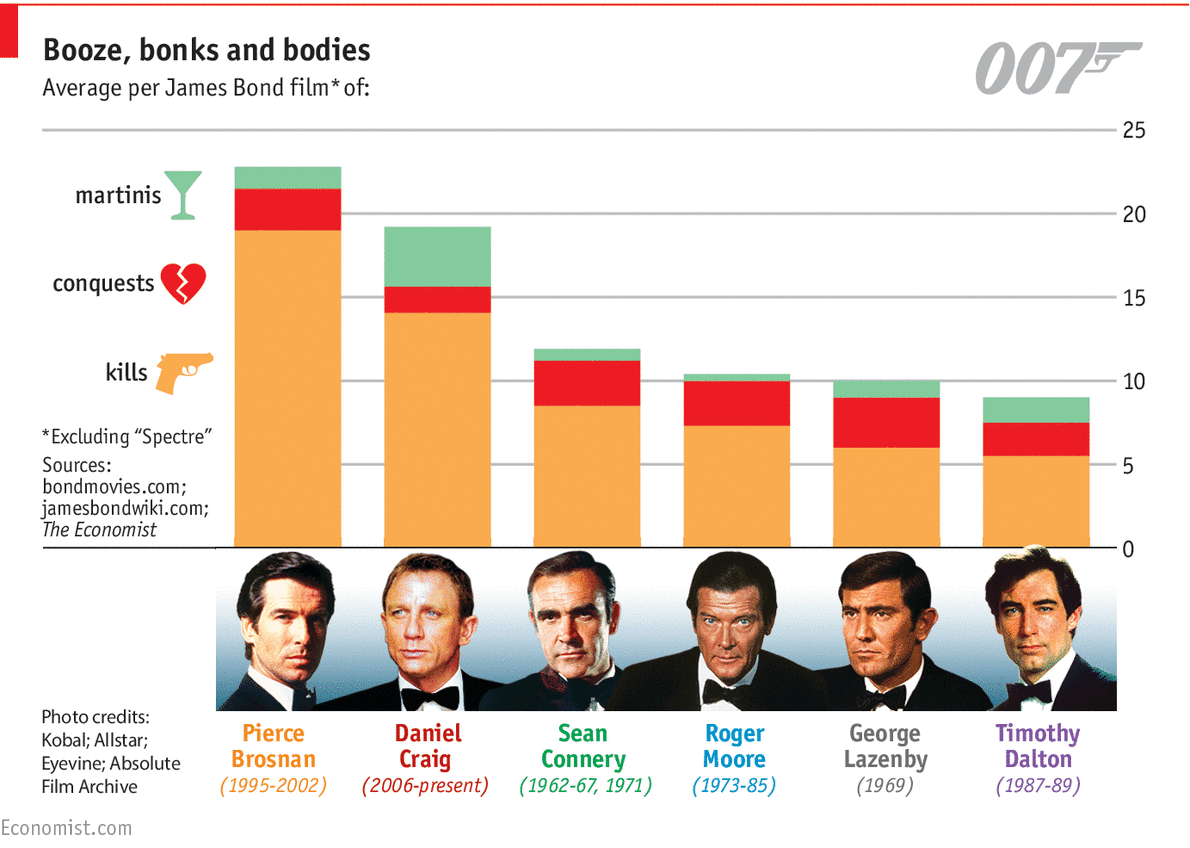
As Bond aficionados (and I count myself one) await the latest Bond movie, The Economist Daily Chart (of which I'm also an aficionado) featured some deeply meaningful charts. These charts just might be as hilarious as a Bond movie.

This first one compares the martini/romances/kill ratio for each of the Bond actors or as The Economist so quaintly puts it, booze, bonks and bodies. Connery had the highest ratio of conquests - why doesn't this surprise me - while Brosnan has the highest proportion of kills - and this did surprise me.


Here's a chart showing the loose connection between ratings (at least as shown on IMDB) and box office success. Click here to view it on the Economist web site where it's interactive.


Monday, November 2, 2015

TOO MUCH CHOICE!

Last weekend my husband and I decided to go to see The Martian. I perused the online listings to choose a time and theatre. But it was much more complicated than that!

Did we want to see the movie in regular seats, or go to a VIP theatre? In 3D, AVX or UltraAVX? Dolby Atmos? And what about D-Box? And different theatres had different combinations of all those special technical features. I was faced with a dozen decisions.

Experiments* have shown that offering too many alternatives dampens consumer purchases. That almost happened in our case, as I came close to giving up in frustration. But we finally opted to see the movie in 3D, with AVX, Atmos and D-Box, in a regular, not a VIP, theatre. Found the D-Box seat vibrations somewhat distracting. If they're going to move the seat around I think they need to pick one point of view - the main character. In this movie, mostly we were supposed to feel like Matt Damon, but sometimes they'd jerk the seat when a piece of equipment fell down as if we were that piece of equipment. Not satisfying.

By the way, really liked the movie. Much better than the last space sci-fi movie I saw, Gravity.

*For those not familiar with this famous experiment, here's how Barry Schwartz describes it in The Paradox of Choice. 
When researchers set up [in a gourmet food store] a display featuring a line of exotic, high-quality jams, customers who came by could taste samples, and they were given a coupon for a dollar off if they bought a jar. In one condition of the study, 6 varieties of the jam were available for tasting. In another, 24 varieties were available. In either case, the entire set of 24 varieties was available for purchase. The large array of jams attracted more people to the table than the small array, though in both cases people tasted about the same number of jams on average. When it came to buying, however, a huge difference became evident. Thirty percent of the people exposed to the small array of jams actually bought a jar; only 3 percent of those exposed to the large array of jams did so.


Saturday, October 31, 2015

Uber vs Taxis

In the last few weeks, I've taken taxis and Uber cars, in Toronto, Ottawa and Montreal. I love the technology-enhanced Uber experience and I thoroughly dislike oligopoly-protected taxis.

I like Uber because:

  • credit card prepayment eliminates the need for cash -  leap out of the car as soon as it stops, a great benefit when time-pressed
  • the email receipt means you can't lose those expense-report receipts. It's also interesting to see how the fare broke down between base fare, distance charge and time charge.
  • a map shows the car coming so you know the car will arrive as promised
  • the driver rating system allows me to decline a driver with a low rating. So far, drivers have been unfailingly polite and the cars immaculate. Having depended on TripAdvisor's crowd-rating system for a great trip in France, I have a lot of confidence in the wisdom of crowds.
  • the fare estimate before you hop into the cab 
  • you can easily split fares, although I haven't used this yet
  • the drivers use Waze to choose best route based on real-time traffic info
  • it's cheaper: I estimate for my recent rides about 30% lower fares. Surge pricing (in effect where demand exceeds supply) does raise prices, to get more cars on the roads
Meanwhile, let me count the reasons I hate cabs. I've ridden taxis without springs. I've been subjected to noisy cabs - the staccato of a dispatcher or the driver's favourite radio station or both. I've endured the  seat belt alarm as the driver never put on his seat belt. On a ride to the Montreal airport, the cabbie spoke almost continuously on his phone. I've been subjected to aggressive cabbie protestors on the way to the Ottawa airport - thankfully they weren't totally blocking traffic that day. I've had a cabbie 'forget' to turn on the meter and then suggest an unrealistic price for the ride.  I've had my credit card refused in Montreal. I've been charged a $1.50 surcharge for using my credit card in Ottawa - a surcharge for heaven's sake, when credit card convenience is a key feature of Uber. And, of course, I've paid consistently more than when using Uber. And that's just in a few weeks.

The Inevitability of Disruption

Most industries have not survived disruption. There's an air of inevitability when incumbents are attacked. When Amazon came along, I continued to patronize book stores. I love book stores and felt very sympathetic to their plight. Yet the siren song of convenience did lure me to buy online, even while suffering great pangs of guilt. And others flocked to Amazon without my ambivalence. 

Taxis are very vulnerable right now. And I for one feel zero - and I mean zero - sympathy for the taxi industry. They have delivered poor service while hiding behind a sick regulatory environment. An industry that convinces politicians that a cab that delivers someone to the airport is not then allowed to pick up a fare - increasing congestion, carbon emissions and generating sublime economic irrationality - does not have the best interest of the consumer at heart. They are wielding their shady business practices for the sole protection of their own pocketbooks. Arguments that these firms paid a lot for their taxi licenses do not move me - so did book store owners invest a lot in their businesses, and they didn't get any help. 

I do feel sympathy for the drivers, who work as feudal serfs for the oligopoly and earn too little to realistically aspire to be Uber drivers because they can't afford a car. Ultimately both cabbies and Uber drivers are at risk of irrelevance in a world of driverless cars. Guess who's got the perfect app to underpin driverless car pick-ups.

Having missed the opportunity to revolutionize the taxi business by developing an app like Uber, they are trying to respond to Uber. Their main efforts have been protests, blockades, and lobbying. Municipal councils are trying to help by imposing rules such as in Montreal: cabbies must open the door for all passengers (just what I need when I'm in a hurry, the cabbie to get out, walk around the car and open the door for me!), must wear a uniform (as if I care how they're dressed), and must accept credit cards. In Toronto, taxis are requesting permission to reduce the base fare. None of this will keep consumers happy, although reactionary regulatory moves might still kill Uber.

It's hard for an incumbent to respond to disruption but the taxi companies are making a complete botch of it. I hope regulators find a way to allow Uber to delight consumers, while working out a reasonable regulatory framework.

For those interested, I've compiled some past responses to disruption, including both successful and unsuccessful approaches.

Responses to Disruption


Since Clay Christensen wrote The Innovator's Dilemma in 1997, it's been clear why incumbents struggle when disruptive innovation assails their industry. Many companies - in fact, whole industries - have succumbed to new disruptive business models. Such business models are often enabled by technology, they usually devastate margins, and they empower a new entrant to address the low end of an existing market, or an entirely new market. Research has shown that failure to address disruption is the single greatest cause of the demise of companies.

Incumbents struggle to come to terms with disruption because it attacks their existing business model and profits. Lowering prices, adapting to lower profit margins, shifting their focus to new customers or embracing a new business model - these are all unattractive to incumbents. Stolidly sticking to an existing business model has proved the death of companies, as dramatically demonstrated by Kodak and Blockbuster. Newspapers have badly botched their response to disruption: they recognized the digital threat way too late, and then they doubled down on the most vulnerable part of their business model, news.

But there are other approaches which have yielded varying degrees of success. Some companies wield the law or regulation.  The music companies' initial response to music downloading was to sue early users of Napster. That didn't stop online music; it's not even clear it delayed it much. Sometimes, such tactics can work: broadcast companies unleashed a regulatory blockade to successfully block Aereo's innovative video distribution technology and send it into Chapter 11 bankruptcy (later bought by TiVo). Taxi companies are working hard to maintain the protection of regulation.

When digital photography disrupted the Fuji shifted out of the film business but exploited their competencies in new chemical markets. Other companies cede the low end of the market, and continue their move upmarket to become a smaller but successful company addressing that niche market.

Another tactic has been to create an autonomous business unit operating with a new business model. IBM famously set up its PC unit in Florida, far from the constrictive confines of its headquarters in Armonk and achieved domination of the PC market for decades. By releasing such units from the shackles of the existing business model companies can liberate such subsidiaries to succeed in the disrupted industry.

Another approach is to move aggressively to a new business model within the existing company. Netflix launched streaming even though it damaged their old profit recipe and antagonized some customers. Their stunning success in streaming (36% of US TV households subscribe to Netflix of 40% that subscribe to streaming) shows how smart that aggressive and early move was. Philips has moved from incandescent bulbs to LEDs. Both companies clearly understood disruption and had read Christensen and have disproved the earlier conviction that the only path to success is through an autonomous company.

No matter how an incumbent responds, facing disruption is unbelievably challenging, and there are more failures than successes.