Showing posts with label non-violence. Show all posts

Thursday, July 21, 2016

Julia Bracha


Make conflicts less violent; have more women in public life. This was the thought-provoking thesis of Julia Bracha in her TED Summit talk.

Her contention runs like this. Since it's futile to try to eliminate all conflicts, what we should be trying to do is to make them less violent. Nonviolent campaigns have two big advantages.  Fewer people are hurt or killed and less infrastructure is destroyed, infrastructure that might be key to recovery after conflict. They also tend to be more successful. And the best predictor of which tactics will prevail (violent or non-violent) is the ideology regarding women in public life. In her research, movements with women in leadership roles have succeeded more often: 53-27*.

It's not that women are less involved in conflicts. It's that they are talented in exercising power and influence nonviolently in the background. Because men are the public face of resistance, we often miss women's quieter, and highly effective, role in the background. Bracha pointed to influential women like Septima Clark in the US civil rights movement who emphasized literacy and education.

The media often underestimates the influence of women in Arab and Muslim communities. Consider the 1st Intifada, where media coverage focused on rocks being thrown at tanks. However 97% of the activities in that Intifada were non-violent tactics (like strikes for instance), and the women were calling the shots in those efforts.

Bracha's film wonderful Budrus, which I saw and loved at Toronto's Hot Docs Festival (reviewed here) highlighted the efforts of the women of the town of Budrus. Budrus was fighting the Israeli security fence, which was slated to go into Palestinian territory and bulldoze olive trees which were their livelihood. The 15-year-old girl who was an inspiration in the battle ultimately planted herself in front of a bulldozer. With the help of Israeli liberals, the Israelis relented and moved the wall to the boundary between Israeli and Palestinian territory instead of its planned incursion into Palestinian territory.


* not sure of the source of this statistic

Friday, January 27, 2012

Latest TED Book Club Selections - January 2012

The latest TED Book Club selections are out.  As always, it's an interesting bunch.

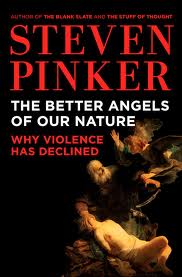
Steven Pinker has given several talks at TED, including his 2007 talk which made a deep impression on me.  He argued that, despite today's news overload focused on bad news, the level of violence and wars has actually been declining in the world.  You can find that talk here.  Apparently the talk sparked further research and analysis and culminated in the publication of a book. 

The Better Angels of our Nature elaborates on that theme, arguing that violence between humans is in long term decline. I remember Pinker showed a graph showing the incidence of wars and numbers of deaths in those wars. I imagine I'll find that one in the book when I get around to it.

A friend recently pointed me to a counterargument presented in a TEDx talk by Jonas Gahr Store, the Norwegian foreign minister, which you can view here.  (Thanks Scott).  Store focuses on a shorter time frame - just since 1946 - and he s argues that violence hasn't really declined overall: the increase in intrastate violence has grown faster than the decline in interstate violence.

I'm really looking forward to reading Pinker's book, to understand more clearly his proposition and the his evidence to support it, and to compare it with Store's point of view.


Also in this batch was Michael Shermer's The Believing Brain.  Shermer is another TED speaker that I enjoyed.  He characterizes himself as a professional skeptic and is the founder of Skeptic Magazine.  His 2006 TED talk was hilarious as he mocked various outrageous beliefs held my many people.  He did a reprise in 2010, unveiling more hoaxes and gimmicks, but also argued that we have a belief engine in our brains which makes us want to believe. The Believing Brain explores further why we believe the weird things we do.  On his web site, Shermer describes the books as "a comprehensive theory on how beliefs are born, formed, nourished, reinforced, challenged, changed, and extinguished."  Again, I'm looking forward to reading this book.  Maybe it will explain to this puzzled Canadian why so many Americans believe in creationism over evolution!


The last book in the mailing was The Fairy Tales of the Brothers Grimm.  This illustrated collection of fairy tales was printed in time for the 200th anniversary of the Brothers Grimm's tales.  A quick glance through the book revealed some tales that I was not familiar with. This should be an eminently skimmable book!


For those interested, there are several other posts about TED Book Club Selections:


Also there are a few reviews of books from the book club:

Sunday, May 2, 2010

Budrus

Budrus is a Palestinian village of 1,500 on the West Bank. The Israelis arrive to to build the security fence - well beyond the 'Green Line' marking the boundary between Israel and the Palestinian territory on the West Bank. This will result in the residents of Budrus losing land and olive groves they depend on for their livelihood.

A leader in the village inspires non-violent resistance. At first the protests involve only the men of the village, but they are soon joined by the women. As word of the protests spreads, some international sympathizers join the protesters. But the tide really turns when Israeli activists arrive to stand side by side with the Palestinians. The Israeli Border Patrol is reluctant to do anything that would result in Israelis being hurt, and many cameras documenting the action serve to keep the army's actions moderated. Frustrated youth finally break ranks and start throwing rocks at the Israeli armored vehicles. But the threat of chaos breaking out is averted and the protest continues mostly peacefully.

Ultimately, the Israelis decide to move the placement of the fence near Budrus. By the, the protests have spread to other villages where the fence has swung substantially within Palestinian territory, and the fence ultimately gets built very close to the Green Line. The Israelis state the change is not due to the protests. As the Billy Joel lyrics to She's Only a Woman go - "she never gives in, she just changes her mind."

The film was created from the film taken by many different people over the course of the protests and was supported by the work of Just Vision (click here for their web site). For those sensitive to hand-held cameras, be warned that some portions of the film are subject to considerable motion.

I would recommend Budrus to anyone who has a chance to see it. It's a heart-warming tale of how non-violence can be effective, and how supposedly antagonistic people can work together in common cause.