The story is about three generations of Rafia Zakaria's family with Pakistan's history as the backdrop. Or maybe the story is about Pakistan with the family's story as the backdrop? Either way, this book is a good read.
The 'upstairs wife' Zakaria's Aunt Amina is forced to live with the ignominy of her husband taking a second wife, moving his first wife upstairs and proceeding to spend alternate weeks with the two wives. Meanwhile, outside the family home, wars, assassinations, massacres, coups, and sectarian violence roils Pakistan's history.
Pakistani women live a cloistered, constrained, demeaning life. Aunt Amina's misery is mirrored in the struggle for women's rights in Pakistan. Benazir Bhutto strides onto the stage holding the great hopes of women, but ultimately slinks off - symbolizing the extreme corruption and venality of Pakistan's political life. High expectations unfulfilled.
Zakaria's family emigrates to Pakistan from India after Partition, also full of high hopes of a better life. But life is not better than it was in India, and in many ways it is worse, certainly economically and socially. Immigrants are disadvantaged compared to the native born; for instance educational opportunities favour those whose fathers and grandfathers both have Pakistani residency.
This book is not plot driven but proceeds in a series of vignettes describing external events and family events, as the title clearly describes. I wasn't particularly fond of this approach, but it was interesting nevertheless. I would recommend this book - particularly if you are unfamiliar with Pakistan's history, as I was. It certainly helped me put into perspective modern events.
Link to other book reviews: click here.
This blog talks about ideas that catch my fancy: TED talks, books (including TED Book Club selections), movies (especially Hot Docs documentaries), travel, and other interesting things I read or hear about.
Showing posts with label India. Show all posts
Sunday, March 20, 2016
Monday, May 6, 2013
Blood Relative
Having recently written a glowing review of The Menstrual Man, here's another tale of an Indian man passionate about making a difference in his country. Vinay Shetty, or Vinay Uncle as he's known to the children he's helped, has championed the cause of children with thalassemia for 15 years as leader of the Think Foundation.
Thalassemia is an inherited genetic disease which affects the blood's ability to make haemoglobin and is usually found in the Mediterranean, West Asia and North Africa. Without treatment, children have a low life expectancy, and even those being treated have a stunted growth, looking years younger than their real age. Those with the disease must receive regular weekly blood transfusions, leading to an iron overload in their system, which in turn must be treated with expensive iron chelation medicine.
In Mumbai, there is no shortage of blood for those transfusions. Shetty, who attended the film and took questions in the Q&A was asked to name the greatest accomplishment of his foundation so far, and he pointed to that availability of blood. The next big challenge is the cost of the chelation medication, even though there is a generic version of the drug manufactured in India, and that is the focus of the foundation's fund-raising. Nevertheless, children born with thalassemia in Mumbai have a life expectancy about 15 years longer than in the rest of India.
Shetty has been working hard to get government help, and since the completion of the movie, the Indian government did announce funding for chelation therapy for those below a certain income level. That still leaves a band of people too poor to afford chelation but not poor enough to make the cut-off, but "it's a start" says Shetty. It seemed to me that focussing on getting government support for genetic screening would be important; such screening is not as emotionally appealing as helping specific children with medication and is harder to get donors to step up to funding.
Shetty also works hard at education and outreach. Tradition still reigns strongly in many Indian households, and we see one mother who believes that praying to the goddess will offer her daughter better protection than chelation therapy. Shetty works to get her on treatment and back in school.
Thalassemia Major is caused when a child inherits the thalassemia recessive gene from each of its parents. Shetty is also pushing for testing of siblings before marriage to see if they are carriers of the recessive gene to provide genetic counselling.
I looked up thalassemia after watching this movie. The disease is most common in the Mediterranean, West Asia and North Africa. Genetic counselling, early screening and detection, and subsequent treatment mean it's not a problem in the west, but it's still a much bigger issue in less developed countries like India. The prevalence of such a genetic disease raises the question of why natural selection has not led to its disappearance. The reason, not mentioned in the movie, is that carrying the thalassemia recessive gene (known there as having thalassemia minor) confers a degree of protection against malaria, which means that gene is being selected for. This is rather similar to sickle-cell anemia, which also seems to confer some resistance to malaria, and one article I read said these two diseases are related. This was all very interesting information, but did not appear in the film. I'm sure the film was stronger because of the resistance of the temptation to include that information, which would have been a distraction from the film's focus on Shetty's efforts.
The director of this film is award-winning Canadian filmmaker Nimisha Mukerji, niece of Vinay Shetty. So the film really was about her 'Vinay uncle'!
Great film.
Thalassemia is an inherited genetic disease which affects the blood's ability to make haemoglobin and is usually found in the Mediterranean, West Asia and North Africa. Without treatment, children have a low life expectancy, and even those being treated have a stunted growth, looking years younger than their real age. Those with the disease must receive regular weekly blood transfusions, leading to an iron overload in their system, which in turn must be treated with expensive iron chelation medicine.
In Mumbai, there is no shortage of blood for those transfusions. Shetty, who attended the film and took questions in the Q&A was asked to name the greatest accomplishment of his foundation so far, and he pointed to that availability of blood. The next big challenge is the cost of the chelation medication, even though there is a generic version of the drug manufactured in India, and that is the focus of the foundation's fund-raising. Nevertheless, children born with thalassemia in Mumbai have a life expectancy about 15 years longer than in the rest of India.
Shetty has been working hard to get government help, and since the completion of the movie, the Indian government did announce funding for chelation therapy for those below a certain income level. That still leaves a band of people too poor to afford chelation but not poor enough to make the cut-off, but "it's a start" says Shetty. It seemed to me that focussing on getting government support for genetic screening would be important; such screening is not as emotionally appealing as helping specific children with medication and is harder to get donors to step up to funding.
Shetty also works hard at education and outreach. Tradition still reigns strongly in many Indian households, and we see one mother who believes that praying to the goddess will offer her daughter better protection than chelation therapy. Shetty works to get her on treatment and back in school.
Thalassemia Major is caused when a child inherits the thalassemia recessive gene from each of its parents. Shetty is also pushing for testing of siblings before marriage to see if they are carriers of the recessive gene to provide genetic counselling.
I looked up thalassemia after watching this movie. The disease is most common in the Mediterranean, West Asia and North Africa. Genetic counselling, early screening and detection, and subsequent treatment mean it's not a problem in the west, but it's still a much bigger issue in less developed countries like India. The prevalence of such a genetic disease raises the question of why natural selection has not led to its disappearance. The reason, not mentioned in the movie, is that carrying the thalassemia recessive gene (known there as having thalassemia minor) confers a degree of protection against malaria, which means that gene is being selected for. This is rather similar to sickle-cell anemia, which also seems to confer some resistance to malaria, and one article I read said these two diseases are related. This was all very interesting information, but did not appear in the film. I'm sure the film was stronger because of the resistance of the temptation to include that information, which would have been a distraction from the film's focus on Shetty's efforts.
The director of this film is award-winning Canadian filmmaker Nimisha Mukerji, niece of Vinay Shetty. So the film really was about her 'Vinay uncle'!
Great film.
Friday, May 3, 2013
The Menstrual Man
If you want to bring sanitary pads to women in conservative, tradition-bound India - and you're a man - you need a particular brand of vision, ingenuity, persistence, and guts. A dash of charisma wouldn't hurt. Muruganantham is such a man. And The Menstrual Man is his story.
Innovators will tell you that the first ingredient of vision is asking the right questions. Muruganantham asked two key questions. Why don't Indian women use sanitary pads? Cost was the answer. And does it really matter if they use cloth instead? Yes it does, because cloth is seldom washed and thoroughly dried in a sterile manner and is thus a conductor of many kinds of infection. Furthermore, availability of truly sanitary pads might enable women to emerge from the isolation they now face during their menstrual periods. Thus began his vision: provide sanitary pads for Indian women at a price they can afford.
Then came the ingenuity. Muruganantham tried many ingenious approaches to the problem, testing with different materials before settling on using cellulose. When he couldn't convince women to test his product, he personally wore a bladder full of pig blood to simulate having a menstrual period so he could test the pads himself. He was able to lick the problem of manufacturing by designing a trio of devices, rather than one integrated machine as used in Western plants.
Muruganantham persisted over many years, before he found the solution to making acceptable pads at a third of the usual price, and also providing employment for the rural women running these machines. He showed guts in persevering when he became an object of derision, and was treated like a pariah by even his wife and mother who both left him.
And then there's his charisma. Uneducated and proud of it, Muruganantham is a compelling speaker, with a great sense of humour and a vibrant energy that leaps off the screen. It's his unquenchable enthusiasm that makes this a great movie experience.
Innovators will tell you that the first ingredient of vision is asking the right questions. Muruganantham asked two key questions. Why don't Indian women use sanitary pads? Cost was the answer. And does it really matter if they use cloth instead? Yes it does, because cloth is seldom washed and thoroughly dried in a sterile manner and is thus a conductor of many kinds of infection. Furthermore, availability of truly sanitary pads might enable women to emerge from the isolation they now face during their menstrual periods. Thus began his vision: provide sanitary pads for Indian women at a price they can afford.
Then came the ingenuity. Muruganantham tried many ingenious approaches to the problem, testing with different materials before settling on using cellulose. When he couldn't convince women to test his product, he personally wore a bladder full of pig blood to simulate having a menstrual period so he could test the pads himself. He was able to lick the problem of manufacturing by designing a trio of devices, rather than one integrated machine as used in Western plants.
Muruganantham persisted over many years, before he found the solution to making acceptable pads at a third of the usual price, and also providing employment for the rural women running these machines. He showed guts in persevering when he became an object of derision, and was treated like a pariah by even his wife and mother who both left him.
And then there's his charisma. Uneducated and proud of it, Muruganantham is a compelling speaker, with a great sense of humour and a vibrant energy that leaps off the screen. It's his unquenchable enthusiasm that makes this a great movie experience.
Friday, April 27, 2012
The Best Exotic Marigold Hotel
What a great movie! Light, frothy, funny, touching, and graced by superb acting by old favourites such as Judi Dench, Tom Wilkinson, Maggie Smith and Bill Nighy, as well as captivating new faces Dev Patel and Tena Desae. And Penelope Wilton as the woman you love to hate. For me, it brought back tremendous memories of our recet trip to India. Lovely people, vibrant colour, and just the right amount of chaos. We spent several days in each of Jaipur and Udaipur where the movie was set, and loved every minute of it.
The Best Exotic Marigold Hotel was definitely targeted at our demographic: let's call it the retired but adventurous crowd. This movie is definitely a five star on my list. I am heading off to my first Hot Docs movie of the year, so it was good to have some light, definitely non-serious entertainment before I start the Hot Docs marathon!
Sunday, November 20, 2011
Glenburn Tea Estate
Our last stop in India was at the Glenburn Tea Estate, a large working tea plantation at an altitude of 3,200 feet in the Himalayas. From our room we could see Mt. Kangchenjunga, the third highest mountain in the world at 28,169 feet. (For reference, Everest is 29,029 feet.)
We had to get up early in the morning to see the mountains, because by 7 a.m., they are cloaked in cloud. It really brings home the tales of climbers who wait for a break in the weather to make their final ascents on these huge mountains.
It's hard to express how awesome these mountains are. That picture above was taken from 130 kms away, tipping the camera up. On the first morning, we missed the view of the full mountain, but we now suspect the very tops of the mountains were visible that day and we mistook them for clouds. Your eye just doesn't look that high for mountains, until you see the full range and realize "Oh my goodness, those mountains really are touching the sky!"
Burra Lodge at Glenburn is the original bungalow built in 1859 by a Scottish tea company, and magnificently restored by the current owners. The Water Lily Bungalow (shown at the left) was built in 2008 and has been furnished with antiques and tasteful decor, right down to traditional antique baths and gorgeous teak floors.
Our room in the Water Lily Bungalow was named the RungDung Suite after the nearby river.
That window seat was my favourite spot to sit and read and absorb the mountains. My husband chose the patio for the same view.
One of the lovely features of Glenburn was the large dinner table which seated all 18 people staying there. (There were several children as well, who were fed before the grown-ups.) Glenburn is very popular with expats who live in Delhi and want to escape the chaos for a serene holidays, and most of the guests fell into this category. Our place cards seated us with different people each night and the conversation was lively and entertaining.

Another great thing about Glenburn was the wonderful gardens. We hadn't seen a lot of flowers growing in gardens in India. (In fact, I was always curious where those thousands of flower petals came from for all those rangolis we saw). But Glenburn was a refreshing burst of flowers for souls starved of flowers. We talked to the gardener one day, who said he had been taking care of Glenburn's gardens for over 50 years! Here are some of the lovely flowers:
We had to get up early in the morning to see the mountains, because by 7 a.m., they are cloaked in cloud. It really brings home the tales of climbers who wait for a break in the weather to make their final ascents on these huge mountains.
It's hard to express how awesome these mountains are. That picture above was taken from 130 kms away, tipping the camera up. On the first morning, we missed the view of the full mountain, but we now suspect the very tops of the mountains were visible that day and we mistook them for clouds. Your eye just doesn't look that high for mountains, until you see the full range and realize "Oh my goodness, those mountains really are touching the sky!"
Burra Lodge at Glenburn is the original bungalow built in 1859 by a Scottish tea company, and magnificently restored by the current owners. The Water Lily Bungalow (shown at the left) was built in 2008 and has been furnished with antiques and tasteful decor, right down to traditional antique baths and gorgeous teak floors.
Our room in the Water Lily Bungalow was named the RungDung Suite after the nearby river.
That window seat was my favourite spot to sit and read and absorb the mountains. My husband chose the patio for the same view.
One of the lovely features of Glenburn was the large dinner table which seated all 18 people staying there. (There were several children as well, who were fed before the grown-ups.) Glenburn is very popular with expats who live in Delhi and want to escape the chaos for a serene holidays, and most of the guests fell into this category. Our place cards seated us with different people each night and the conversation was lively and entertaining.

Another great thing about Glenburn was the wonderful gardens. We hadn't seen a lot of flowers growing in gardens in India. (In fact, I was always curious where those thousands of flower petals came from for all those rangolis we saw). But Glenburn was a refreshing burst of flowers for souls starved of flowers. We talked to the gardener one day, who said he had been taking care of Glenburn's gardens for over 50 years! Here are some of the lovely flowers:
Saturday, November 19, 2011
Turbans
During our recent trip to India, I became fascinated with turbans. There were many beautiful turbans, in a variety of colours, and wrapped in rather exotic patterns. One man demonstrated to me how he wrapped his turban - he did it so efficiently it was amazing.
These turbans aren't simply decorative though. The colours of the turban indicate who you are; for example in one region shepherds wore an orange turban, in another area yellow. Although we were assured many times that the caste system is dead in India, most of our guides self-identified the caste they were from, and often identified others that way. So it still seemed fairly top of mind to me.
I've appended some photos of turbans I particularly liked. You'll notice that most of the men wearing these turbans are older, so perhaps the practice is melting away with the younger generation. The exception is where I was taking pictures of hotel employees wearing local dress; they were much easier to pose so there are a few of those
Wednesday, November 16, 2011
Jodhpur
Jodhpur is an interesting city of a million people. It's called the Blue City because of its indigo painted houses. This is done because there is something in the paint that repels insects - another example of ecologically sound traditional practices in India. Our hotel, the Raas, featured lots of red stone cut in interesting shapes, and had the upper stories painted blue.We had a beautiful view of the Mehrangahr Fort from our hotel balcony. This picture of the fort catching the sun at dawn also catches the hotel pool - a touch of the old and new together which rather appealed to me.
What the picture doesn't capture is the mosque that was just off to the right with the loudspeaker that announced prayer at 4:45 in the morning, right at the level of our room. If there's a scale for how loud a loudspeaker can be, this one had to be a 10! The hotel handed out ear plugs, but they were insufficient. It was a shame, because it was such a nice hotel in every other way.
We visited the fifteenth-centry Mehrangahr Fort, perched on the hill above the town. Legend has it that to build the fort the local ruler had to displace a hermit, who promptly uttered a curse that the place would always suffer from water scarcity. Although he built a house and temple for the hermit at the fort, the ruler felt compelled to bury a man alive in the foundations of the fort to propitiate the gods and remove the curse. The family of this man still lives in Jodhpur, supported by the local ruler, and the extended family is invited to special events as honoured guests.Another grisly aspect of the fort was the plaque with the handprints of the 30 wives who self-immolated upon the death of their husband in 1843. Sati is now banned in India but it is amazing that it was still being practised as late as the 19th century.
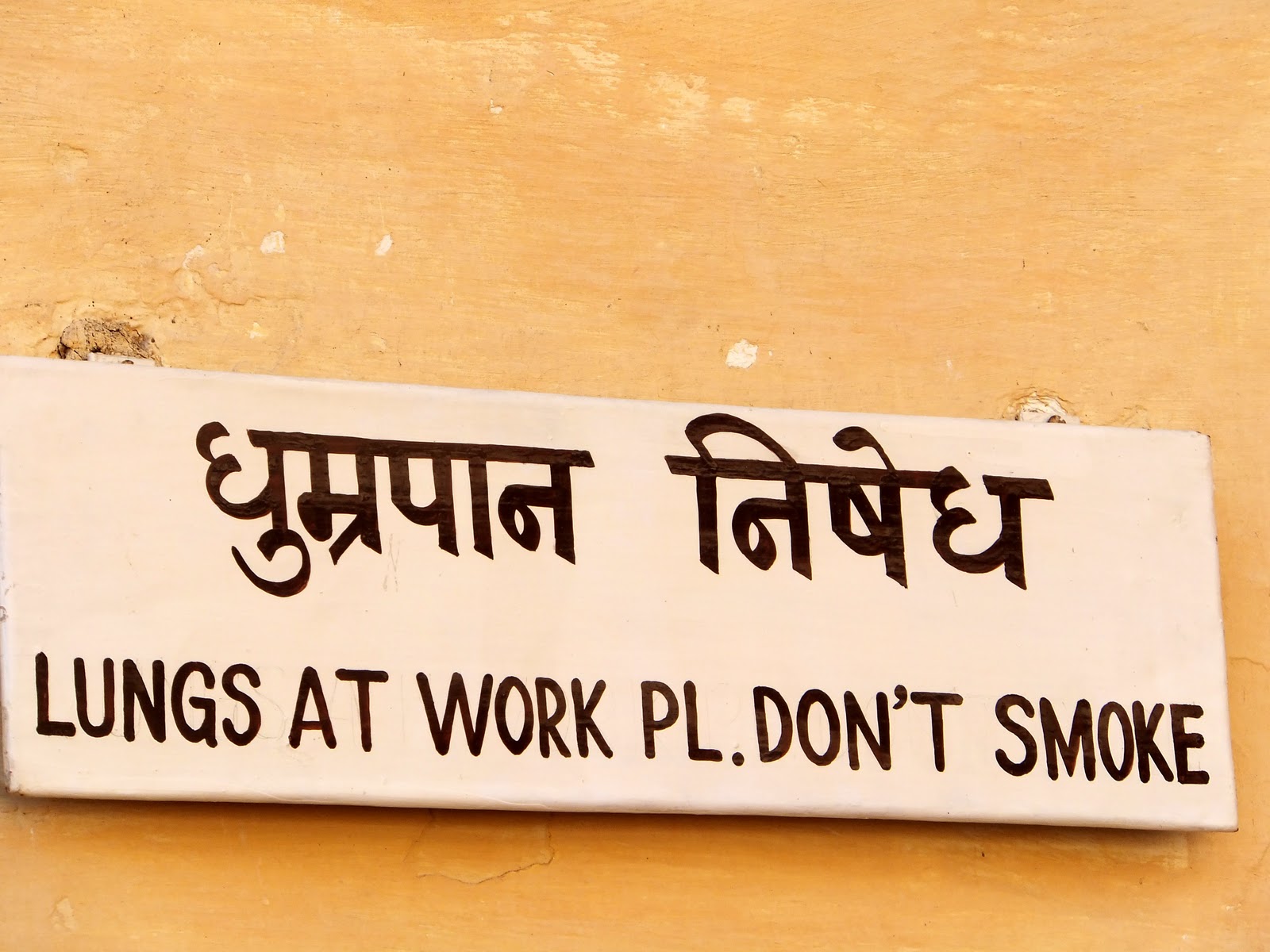
The fort had many lovely rooms and a good museum. A sign that had me laughing out loud was the no smoking sign. This sign was posted outdoors, something we saw a few times in India. One of the remarkable things about India was the dearth of smokers we saw around the country. Almost all the smokers we saw were Europeans.Wednesday, November 9, 2011
Dabbawallas
In Mumbai, about 5,000 dabbawallas deliver 200,000 lunches a day to city workers. The system started in the 19th century and perseveres today, although apparently the number of lunches has started to decline.
A dabbawalla picks up freshly made hot lunches from homes in the suburbs in mid-morning. Our guide pointed out that you better have the lunch ready when they arrive - even if it's a bit before their scheduled time - because if it's not ready they go without it! One dabbawalla collects many lunches and takes them on special dabbawalla trays, loaded onto bicycles, pushcarts or carried on their head, and takes them to the train, where they are placed in a special car on the train. When they arrive at the Churchgate station in central Mumbai, they are picked up by more dabbawallas and sorted for delivery to their final destination at 12:30. Empty tiffin boxes are returned home in the afternoon. The tiffin boxes pass through several hands and travel on bicycles, handcarts, trains or on heads to reach their destinations and undergo several sorting processes along the way.
The amazing thing is that this is a totally manual process, and is based on a proprietary (some say secret) coding scheme that is used by the dabbawallas, many of whom are illiterate. You can see the coding painted on the traditional tin tiffin box below; magic markers are used on the cloth bags and thermoses which are more the modern fashion. I got a picture of a partially sorted tray of tiffins.
Does the central sorting station make you think of FedEx's hub in Memphis? It certainly did for me.
And it's not quite fair to say the entire process is manual. Dabbawallas are now accepting orders through SMS. It is also SMS which is also killing the old habit of slipping messages into the tiffin box - why do that when you can fire off a text message?
Being a dabbawalla is a traditional job mainly held by people from the Pune area of India. The organization has very little management superstructure and is held in a charitable trust. Dabbawallas have to make an investment of two bicycles, a wooden crate for the tiffins, white cotton kurta pajamas, and the trademark white Gandhi cap. All the profits are distributed at the end of every month and come to about $40-$80. It costs less than $4 for the customer to have this amazing delivery service for a month!
What is astonishing about this system is its incredible accuracy and timeliness. Forbes magazine awarded the system Six Sigma certification in 2001, based on its 99.999999% accuracy rate which implies less than 1 error in 16 million.
Having read about this system, I was fascinated to see it, and expected to observe high intensity and even frenzy at the sorting stations. However, we watched the tiffin boxes being sorted on the sidewalk outside Churchgate Station and the scene was totally calm, even leisurely, although very organized. We'd been told the dabbawallas weren't fond of people getting in their way and taking lots of photos (understandable), so I have limited good pictures of the whole exercise. Here's a picture of some of the trays ready to go; it's a heavy load for one person to carry or push. Some bikers head off with tiffins hanging from every part of their body and the bike!
For those who think that a successful organization absolutely requires rigid top-down management, the Nutan Mumbai Tiffin Box Suppliers Charity Trust of Mumbai is a great counterexample.
A dabbawalla picks up freshly made hot lunches from homes in the suburbs in mid-morning. Our guide pointed out that you better have the lunch ready when they arrive - even if it's a bit before their scheduled time - because if it's not ready they go without it! One dabbawalla collects many lunches and takes them on special dabbawalla trays, loaded onto bicycles, pushcarts or carried on their head, and takes them to the train, where they are placed in a special car on the train. When they arrive at the Churchgate station in central Mumbai, they are picked up by more dabbawallas and sorted for delivery to their final destination at 12:30. Empty tiffin boxes are returned home in the afternoon. The tiffin boxes pass through several hands and travel on bicycles, handcarts, trains or on heads to reach their destinations and undergo several sorting processes along the way.
The amazing thing is that this is a totally manual process, and is based on a proprietary (some say secret) coding scheme that is used by the dabbawallas, many of whom are illiterate. You can see the coding painted on the traditional tin tiffin box below; magic markers are used on the cloth bags and thermoses which are more the modern fashion. I got a picture of a partially sorted tray of tiffins.
Does the central sorting station make you think of FedEx's hub in Memphis? It certainly did for me.
And it's not quite fair to say the entire process is manual. Dabbawallas are now accepting orders through SMS. It is also SMS which is also killing the old habit of slipping messages into the tiffin box - why do that when you can fire off a text message?
Being a dabbawalla is a traditional job mainly held by people from the Pune area of India. The organization has very little management superstructure and is held in a charitable trust. Dabbawallas have to make an investment of two bicycles, a wooden crate for the tiffins, white cotton kurta pajamas, and the trademark white Gandhi cap. All the profits are distributed at the end of every month and come to about $40-$80. It costs less than $4 for the customer to have this amazing delivery service for a month!
What is astonishing about this system is its incredible accuracy and timeliness. Forbes magazine awarded the system Six Sigma certification in 2001, based on its 99.999999% accuracy rate which implies less than 1 error in 16 million.
Having read about this system, I was fascinated to see it, and expected to observe high intensity and even frenzy at the sorting stations. However, we watched the tiffin boxes being sorted on the sidewalk outside Churchgate Station and the scene was totally calm, even leisurely, although very organized. We'd been told the dabbawallas weren't fond of people getting in their way and taking lots of photos (understandable), so I have limited good pictures of the whole exercise. Here's a picture of some of the trays ready to go; it's a heavy load for one person to carry or push. Some bikers head off with tiffins hanging from every part of their body and the bike!
For those who think that a successful organization absolutely requires rigid top-down management, the Nutan Mumbai Tiffin Box Suppliers Charity Trust of Mumbai is a great counterexample.
Tuesday, November 8, 2011
Towers of Silence
Indian Parsis (or Parsees) are members of the Zoroastrian religion and descendents of the original Parsis in Iran. The number of Parsis in India has been dwindling, and may number as few as 50,000, mostly concentrated near Mumbai, with forecasts that the number will fall further to about 23,000 by 2020.
Zoroastrians believe that a dead body is contaminated and must neither be buried (where it would pollute the earth) or cremated (where it would pollute fire). In order to avoid this pollution, dead bodies are placed near the top of an open circular tower, exposed to sun and to birds of prey. After about a year, the bones are collected in an ossuary pit at the bottom of the tower, and the final deterioration of the bones is assisted by applications of lime. Eventually rain water washes the remains through various filters out to sea.
The name Tower of Silence was given to these towers by a British translator in the 19th Century. I had heard of Towers of Silence from two separate sources: an article four years ago in The Economist, and in A Son of the Circus set in Mumbai and reviewed in a previous post.
We visited the "Hanging Gardens" at the top of Malabar Hill in Mumbai, an upscale residential area in Mumbai. The Gardens are a lovely urban oasis in a busy city, with a pleasant view over the smog-covered city below. They sit immediately adjacent to the Mumbai Tower of Silence. The park is built on top of an enclosed reservoir; it's said the reservoir was originally enclosed to avoid contamination from the Tower of Silence.
There is a major problem these days with the towers: the vultures on whom they depend are being devastated by diclofenac, a drug used to treat cattle (as described in detail in this article from The Economist). Vultures not only help with human bodies in Towers of Silence; they are a key part of the Indian ecosystem in getting rid of the carcases of cattle and buffalo. Since Indians don't eat much beef and revere sacred cows and since there are about 200M cattle and buffalo in India used exclusively for milk, Indian farmers have depended on vultures to dispose of their carcases. These cows have been the carriers of diclofenac to the vultures.
Both vultures and Parsis are dwindling in numbers. Sadly, it's a question of who will outlast whom. The good news for the vultures is that diclofenac is now banned (though farmers are allowed to use up their old stocks), and there are conservationists breeding vultures in captivity. Meanwhile, Parsis are experimenting with other techniques such as installing solar relectors to speed up the action of the sun.
The name Tower of Silence was given to these towers by a British translator in the 19th Century. I had heard of Towers of Silence from two separate sources: an article four years ago in The Economist, and in A Son of the Circus set in Mumbai and reviewed in a previous post.
We visited the "Hanging Gardens" at the top of Malabar Hill in Mumbai, an upscale residential area in Mumbai. The Gardens are a lovely urban oasis in a busy city, with a pleasant view over the smog-covered city below. They sit immediately adjacent to the Mumbai Tower of Silence. The park is built on top of an enclosed reservoir; it's said the reservoir was originally enclosed to avoid contamination from the Tower of Silence.
There is a major problem these days with the towers: the vultures on whom they depend are being devastated by diclofenac, a drug used to treat cattle (as described in detail in this article from The Economist). Vultures not only help with human bodies in Towers of Silence; they are a key part of the Indian ecosystem in getting rid of the carcases of cattle and buffalo. Since Indians don't eat much beef and revere sacred cows and since there are about 200M cattle and buffalo in India used exclusively for milk, Indian farmers have depended on vultures to dispose of their carcases. These cows have been the carriers of diclofenac to the vultures.
Both vultures and Parsis are dwindling in numbers. Sadly, it's a question of who will outlast whom. The good news for the vultures is that diclofenac is now banned (though farmers are allowed to use up their old stocks), and there are conservationists breeding vultures in captivity. Meanwhile, Parsis are experimenting with other techniques such as installing solar relectors to speed up the action of the sun.
Monday, November 7, 2011
Riding a Camel in Jaiselmer
Riding a camel is not quite as easy as it looks when you see Lawrence of Arabia loping across the sands in a movie.
When we were in Jaiselmer, our tour included a late afternoon ride across the sand dunes on a camel. We had been in the Thar Desert for some time now, the third largest desert in the world after the Sahara and the Simpson in Australia. Most of the desert has been rocky desert and, after the best monsoon in years, it has been uncharacteristically green. However, there is a small area just outside Jaiselmer with dunes.
Jaiselmer is a major tourist magnet. Jaiselmer itself boasts a huge fort on the hill, like many places we've visited, still populated by 5,000 people inside that fort. It had many havelis (mansions) with richly carved ornamentation. It was the first place we really felt the press of tourists, as we met many tour buses on the road to and from Jaiselmer, intermingled with the many army vehicles (Jaiselmeer is only 100 miles from the Pakistan border and the military is quite beefed up here). Many of the tours were domestic tourists. Jaiselmer is the setting for many Bollywood movies, and that draws Indian tourists the way Salzburg draws fans of The Sound of Music.
So, you've been waiting to hear about that camel ride. We had seen camels beside and on the road for a few days as we headed west in Rajasthan, but at the Sam Dunes, as they're known, there were hordes of camels, with their brightly colored saddles and streams of people setting off single file to the dunes.
Our guide picked out a camel for me and then led me around the left side to mount the camel, which is sitting low on the ground with his knees folded under him. Suddenly the camel jumped up, much to the dismay of the guy holding the reins, not to mention me!!!!! So, on to choose another, hopefully calmer, camel. I gingerly sat in the saddle, and the camel straightened his back legs. At this point, one is perched precariously at about a 70 degree angle pitched forward toward the ground. The camel then rockily gets off his knees and stands up straight and you breathe a sigh of relief that you haven't pitched forward off the beast.
The most uncomfortable thing is that the camel is very wide, and the saddle holds you in a tight position, so your legs are spread very wide, resulting in a lot of pressure on your hips if you're built like me. Anyway, we got off to a lumbering walk, accompanied by two guys, one young and one ancient, holding the reins.
Except for when the camel was going downhill, or when he lowered his head to crop some brush, it was relatively comfortable swaying ride, except for those darned spread legs. So I decided to call it a day and head back to the 'camel parking lot'. Immediately, the two guys, both the young and the old, whipped out their mobiles to call back to our driver who came out partway to meet us and put me out of my misery - quite literally. Quite an experience all in all.
Highway Driving in India
It's said that you need three things to drive in India: a good horn, good brakes, and good luck.
Horns are used incessantly in India to indicate that you are about to overtake and virtually never to show impatience or irritation. In fact, trucks usually have signs on the back requesting you to 'Blow Horn' or 'Horn Please'. A rear view mirror seems to be the appendix of an Indian vehicle, a vestigial organ of no discernible current use.
Turn indicators are also vestigial organs. However, manual turn indicators are sometimes used. On the busy road connecting Mumbai to Delhi we were trapped behind a long line of transport trucks which our driver deftly passed, often a few at a time. We were puzzled by the man hanging off the left hand side of a big touring bus in front of us standing on the running board. (Remember we're driving on the left hand side here). We finally figured out his task; after the big bus had overtaken a truck, his task was to warn trucks that the bus was coming back in to the left lane and the truck had to slow down to let him in.
Brakes are important because you never know when you're going to have to slow to a crawl for a piece of road that has been completely washed out by the monsoons or for a speed bump which may appear even in a 4-lane highway. And then there are cows, sheep, goats, bullocks, camels, water buffalo, pigs, chickens, and dogs which may amble, stand or lie in front of you. Then there are the vehicles overtaking a car from the other direction and straying into your lane. The oncoming vehicle is expected to slow down to give the driver time to return to his own lane, or perhaps take to the shoulder to let him keep coming. Size matters in these contest. Everyone gives way to buses or trucks. Then come jeeps, cars and vans like ours. The auto-rickshaws are lower on the totem pole, and motorcycles and bikes bring up the rear.
Our driver was always alert, cautious and we were very thankful to have such a competent driver in these conditions.
Most of the accidents we saw were overturned vehicles, not too surprising, given that so many vehicles are wishfully loaded - 'I wish I had a vehicle that could legitimately carry this much stuff'.
Whereas in Canada a pedestrian can be fined for jaywalking, in India, pedestrians always have right of way. Simply walk into the road, raise your hand just above waist height and give a gentle to and fro waving motion and the cars (mostly) stop for you.
Driving - and crossing streets - in India is an adventure!
** Apologies to anyone who has read before. I accidentally deleted several posts and am restoring them
Turn indicators are also vestigial organs. However, manual turn indicators are sometimes used. On the busy road connecting Mumbai to Delhi we were trapped behind a long line of transport trucks which our driver deftly passed, often a few at a time. We were puzzled by the man hanging off the left hand side of a big touring bus in front of us standing on the running board. (Remember we're driving on the left hand side here). We finally figured out his task; after the big bus had overtaken a truck, his task was to warn trucks that the bus was coming back in to the left lane and the truck had to slow down to let him in.
Brakes are important because you never know when you're going to have to slow to a crawl for a piece of road that has been completely washed out by the monsoons or for a speed bump which may appear even in a 4-lane highway. And then there are cows, sheep, goats, bullocks, camels, water buffalo, pigs, chickens, and dogs which may amble, stand or lie in front of you. Then there are the vehicles overtaking a car from the other direction and straying into your lane. The oncoming vehicle is expected to slow down to give the driver time to return to his own lane, or perhaps take to the shoulder to let him keep coming. Size matters in these contest. Everyone gives way to buses or trucks. Then come jeeps, cars and vans like ours. The auto-rickshaws are lower on the totem pole, and motorcycles and bikes bring up the rear.
Our driver was always alert, cautious and we were very thankful to have such a competent driver in these conditions.
Most of the accidents we saw were overturned vehicles, not too surprising, given that so many vehicles are wishfully loaded - 'I wish I had a vehicle that could legitimately carry this much stuff'. Whereas in Canada a pedestrian can be fined for jaywalking, in India, pedestrians always have right of way. Simply walk into the road, raise your hand just above waist height and give a gentle to and fro waving motion and the cars (mostly) stop for you.
Driving - and crossing streets - in India is an adventure!
** Apologies to anyone who has read before. I accidentally deleted several posts and am restoring them
Why Do Cows Lie in the Road?
Coming to India, one has been prepared to expect cows on the road. The odd one, here and there. What I hadn't expected was the sheer number of cows, on the streets and alleys in large towns and small, and on the highways. And not just walking around - lying in the middle of the road! Rather dangerous, one might think, even in India where cows are sacred animals and carefully avoided.
The explanation? In the extreme heat, some of the chemicals from the asphalt are emitted from the pavement, and those chemicals deter mosquitos and other bugs.
** Apologies to anyone who has already read this - I accidentally deleted a few posts and am now reposting them.
The explanation? In the extreme heat, some of the chemicals from the asphalt are emitted from the pavement, and those chemicals deter mosquitos and other bugs.
** Apologies to anyone who has already read this - I accidentally deleted a few posts and am now reposting them.
Divali in Mumbai
If you look up Divali on Wikipedia, it is described as a festival of lights honouring good over evil, celebrated by both Hindus and Jains. There are five days to the festival, each with separate significance.
But in Mumbai, everyone we asked described Divali as the festival to honour Lakshmi, the goddess of prosperity. This festival has been highly commercialized because it is considered an auspicious time for important purchases and proper observances will set you up for a prosperous upcoming year. Hence we saw huge billboards and newspaper ads encouraging people to get out there and shop: cars, furniture, home renovations, but most of all gold, both as a jewelry and an investment.
Divali is called the Festival of Lights but it seemed to me it could equally be called the Festival of Flowers. Buildings and cars were festooned with flowers, mostly marigolds, and rangolis were painstakingly shaped with flower petals on floors everywhere. Markets were full of clay saucers, to be filled with tiny candles floating in oil, and placed decoratively inside or outside buildings, or within rangolis. We saw a rangoli etched out with glittery powder and sprinkled with candles on the pavement in front of one shop, which was very pretty as it sparkled in the night.
We had spoken to some hotel staff about Divali and when we arrived back from breakfast, we were greeted with wide conspiratorial smiles. When we opened the door to our room, we were surprised and delighted to see that our room had been decorated for us, with a rangoli, and an elephant (representing Ganesh, the elephant of good fortune) decorated with flower petals.
Divali lasts for five days and Mumbai is reputed to celebrate most vigorously, especially with fireworks and firecrackers. We were at Marine Drive to enjoy the first night of Divali. Marine Drive is a boulevard that borders the bay in Mumbai, with wide sidewalks for strolling and a cement wall for sitting to appreciate the view. It gracefully curves around the bay and is dubbed 'The Queen's Necklace' at night.
On Divali along Marine Drive there were clusters of people were setting off things every few feet - six-foot high sizzlers on the ground, noisy crackers that startled you with loud bangs, beautiful fireworks shot into the sky. The cacophony was continuous and the air was filled with smoke. You had to keep your wits about you, as you might be standing looking at one display, to find another being lit right behind you, or perhaps a dud firework that had been shot high in the air coming to land near you. I found this short video on YouTube which captures the randomness of the firecrackers and fireworks very well.
It was such a contrast to Canada, where everything is so controlled, with planned fireworks by municipal authorities, let off by certified fireworks people, and with the crowds a specified safe distance from the point of lighting. Here very young children would dash up to the fireworks with sparklers to light them up. It was up to the crowd to be alert and stay clear of the explosions on all sides. It was similar to the Duresha celebrations where giant effigies 90 feet tall were burned, and people were standing very close. The effigies were supported by guy wires to force them to fall in place, but any surprises would have been quite devastating to the crowd. It was great to be part of something so different.
One lovely custom of Divali is that on the third day, brothers are supposed to visit their sisters. The sister ties a rakhi, a colourful thread, around the wrist of the brother, signifying the strong bond between brother and sister. The brother brings a gift to the sister. One of our guides said that he had given his sister a card. That seemed a bit modest compared to what we'd heard about. It turned out to be a credit card! His sister is studying in university and he had offered to help her, but she had declined preferring instead to earn her own money as a tutor, he said proudly. I think he is quite confident his credit card won't be abused. In a society of multi-generation families, where the wife lives with her husband' family, this custom to strengthen the bond between brothers and sisters is quite heartwarming.
We had spoken to some hotel staff about Divali and when we arrived back from breakfast, we were greeted with wide conspiratorial smiles. When we opened the door to our room, we were surprised and delighted to see that our room had been decorated for us, with a rangoli, and an elephant (representing Ganesh, the elephant of good fortune) decorated with flower petals.
Divali lasts for five days and Mumbai is reputed to celebrate most vigorously, especially with fireworks and firecrackers. We were at Marine Drive to enjoy the first night of Divali. Marine Drive is a boulevard that borders the bay in Mumbai, with wide sidewalks for strolling and a cement wall for sitting to appreciate the view. It gracefully curves around the bay and is dubbed 'The Queen's Necklace' at night.
On Divali along Marine Drive there were clusters of people were setting off things every few feet - six-foot high sizzlers on the ground, noisy crackers that startled you with loud bangs, beautiful fireworks shot into the sky. The cacophony was continuous and the air was filled with smoke. You had to keep your wits about you, as you might be standing looking at one display, to find another being lit right behind you, or perhaps a dud firework that had been shot high in the air coming to land near you. I found this short video on YouTube which captures the randomness of the firecrackers and fireworks very well.
It was such a contrast to Canada, where everything is so controlled, with planned fireworks by municipal authorities, let off by certified fireworks people, and with the crowds a specified safe distance from the point of lighting. Here very young children would dash up to the fireworks with sparklers to light them up. It was up to the crowd to be alert and stay clear of the explosions on all sides. It was similar to the Duresha celebrations where giant effigies 90 feet tall were burned, and people were standing very close. The effigies were supported by guy wires to force them to fall in place, but any surprises would have been quite devastating to the crowd. It was great to be part of something so different.
One lovely custom of Divali is that on the third day, brothers are supposed to visit their sisters. The sister ties a rakhi, a colourful thread, around the wrist of the brother, signifying the strong bond between brother and sister. The brother brings a gift to the sister. One of our guides said that he had given his sister a card. That seemed a bit modest compared to what we'd heard about. It turned out to be a credit card! His sister is studying in university and he had offered to help her, but she had declined preferring instead to earn her own money as a tutor, he said proudly. I think he is quite confident his credit card won't be abused. In a society of multi-generation families, where the wife lives with her husband' family, this custom to strengthen the bond between brothers and sisters is quite heartwarming.
Saturday, October 22, 2011
Nagaur
Many of the forts and palaces we've seen have been Mughal and reflected Islamic architecture and painting; this fort is completely Hindu. But what was most interesting was to have a peek into a historical site in the process of reparation. Because the Maharajah who owned the fort was in Jodhpur, this vast area lay unoccupied for hundreds of year, until the Indian army was stationed here during 60s. The fort took a real beating during their visit, and this has made the job of restoration even bigger. There was a small museum area within the fort, describing the efforts at restoration, which was particularly handy because of our guide's weakness in English.
Many rooms and their beautiful paintings have been restored, for example the room shown below.
The areas of the fort were positioned to maximize air flow during the summer months for natural cooling. On the roof was a square structure cunningly designed to catch and funnel the wind, from whichever direction it was blowing, down a vent and into the rooms below:
Water pressure delivered water from cisterns on the roof (shown in picture) to power all the fountains, with oxen working to pump the water up. I couldn't help thinking how much I would have loved living here, but also how much water-starved peasants must have hated the whole idea of all that water being used for bathing, while they struggled for enough for sustinence and agriculture.
Our driver Harnam taught us the expression ABC (Another Bloody Castle) which can be applied to some trips to India. With the natural cooling and the many pools and baths spread around, and the ecological soundness of this fort, it was far from an ABC. Nagaur would qualify as an eco-resort in modern times.
Subscribe to:
Posts (Atom)