Showing posts with label Steve Jobs. Show all posts

Monday, December 5, 2011

Jobs and Jobs


In Steve Jobs, author Walter Isaacson mentions how deeply Jobs was influenced by Christensen's book The Innovator's Dilemma.  But there's another point of intersection between Jobs and Christensen. 

Clayton Christensen has popularized the notion of organizing yourself by considering Jobs to be Done.  Think of customers as people who hire your product to get a job done.  No one wants a 3/4" drill; they want a 3/4" hole.  Christensen advocates organizing your market research around understanding what jobs people need to get done, and to designing your products around getting those jobs done.

The Apple stores were designed around Christensen's idea of Jobs to be Done (although that connection is not explicitly mentioned by Isaacson).

Here's how it happened.  Jobs had decided that in order to control the entire customer experience, Apple had to have retail stores.  The board thought he was crazy.  Jobs knew the way to convince them was to build a prototype store for them to see.

He recruited Ron Johnson, who had been VP for merchandising at Target, to design the stores.  By October 2000, the prototype was just about ready to unveil: a stark minimalist style, designed with Apple flair, and organized around Apple products.  But then Johnson had an epiphany and realized the store needed to organized around the jobs that people want to do, like listening to music, or managing photos.

Apple store - Tyson's Corners
 There was an explosion as Jobs recoiled from the prospect of such a major redesign.  However, after sleeping on it, Jobs knew Johnson was right, and the launch was deferred for a few months in order to get it right. 

A new prototype was built, the board was convinced, and the first Apple store opened in May 2001 in Tyson's Corners, Virginia.

Sunday, November 27, 2011

TED Book Club Selection - November 2011

 Today, the lastest TED Book Club Selection arrived, Walter Isaacson's biography Steve Jobs.  What an appropriate choice!  Both TED and Jobs stand for Technology, Entertainment and Design. I've received many comments on my posts about TED book selections, showing that many people enjoy hearing what the folks at TED have chosen.  So I decided to post this, even though I've barely begun the book.
 

Jobs life is linked to three inspirations in my own life: Clayton Christensen, TED and Ian Sharp. 

 
It's said that Jobs was inspired by Clayton Christensen's book The Innovator's Dilemma, and that it was pivotal in molding his views about innovation.  I've talked about Christensen's ideas in previous posts (such as this one).  I celebrated the fact that The Innovator's Dilemma was chosen as one of the six best business books of all time(click here), and that Christensen was named the top Business Thinker (click here).  These posts explain why I think Christensen's ideas are so important, and if you examine the trajectory of Jobs' career, you can see his products as an illustration of Christensen's theories.  Consultants from Innosight (the firm founded by Clayton Christensen) had a great article about the innovation lessons learned from Steve Jobs.  I've seen lots written about Jobs recently, but that assessment is my favourite.

Jobs' life is an illustration of the very essence of the TED conference.  So many conferences bring together people with shared interests in a particular field.  They are very focused, and can often provide deep information, but seldom any true inspiration because they simply reinforce an industry's entrenched way of thinking.  TED is different - it brings together people from a wide variety of disciplines and the sparks of creative and innovative thinking fly.  Jobs similarly capitalized on the breadth and depth of his interest in technology, entertainment and design in the breathtaking innovation in his products.  In just the first few chapters, there have been appearances by people I've met at TED like Larry Brilliant and Stewart Brand, and the index reveals more to come.


The description of those early days in Silicon Valley brings back memories of my early days in  timesharing (now called cloud computing) in the early 70s in Canada.  I worked for I.P. Sharp Associates, a pioneering software and network communications company, led by the brilliant and unassuming Ian Sharp (shown at left).  Ian's penchant for hiring bright people resulted in a company full of them.    Like Jobs, many 'Sharpees' had dropped out of university  (often leaving the US motivated by the Vietnam draft).  Like Jobs, some of them had nevertheless earned a BA (brilliant & abrasive) or a BE (brilliant & eccentric).  Ian exhibited huge tolerance of eccentric behaviour as long as people were contributing and were respectful of their colleagues and focussed on solving customer problems.   Jobs' success arose, at least in part, from the diversity of his interests and his appetite for ingesting ideas from many fields. Ian's disregard for people's area of specialization meant that I.P. Sharp was seething with people from diverse backgrounds - computer science as well  as education, mathematics, biology, music and many fields.  (It was also full of 'minorities', because Ian seemed blind to nationality, religion, skin colour, or sexual orientation).

Authorized biographies often present a somewhat varnished version of events.  What has surprised me so far about this book is that it shines a glaring light on both Jobs' brilliance and his less desirable traits.  Jobs and Wozniak have just founded Apple, and Jobs' trademark chutzpah, passion and single-minded drive are already evident.  The reality distortion field has made its appearance.  So has Jobs' arrogance, although that aspect of his personality remains to be polished and honed.  His penchant for abuse and his 'anti-loyalty' is disturbing to read about.   Perhaps it's a final comment on Jobs' unfailingly high  self-esteem that he was willing to support a book that could present him in such an unforgiving light.


Friday, October 7, 2011

Jobs headlines in Indian papers

Indian papers, like everywhere I guess, had full front pages of Jobs info. These papers love their puns! Here's a sample from The Times of India and The Economic Time:

iQuit, Jobs Well Done

Jobs Takes iWay to Heaven

An iCon Who Revolutionized .....

I find Indian papers much more colourful than ours. They may start with 'such and such a ministry has got all their facts wrong'. No pussyfooting around with starting with official version and then gradually showing some factual weaknesses. And, as shown above, a marvelous inclusion of puns!

Monday, August 29, 2011

Steve Jobs

How sad to see Steve Jobs unable to continue at Apple.  From when he was very young, Jobs has broken all the rules and made it work for him.  I wonder how many university drop-outs have used him as a justification for their actions.

And so the speculation swirls as to what will happen with Apple.  Tim Cook, Jobs' successor, has been written about in very flattering terms, but he's all about how to do business: he's fixed various supply chain problems and been critical to Apple's success in bringing products to market.  Jonathon Ives, Apple's famous and revered designer, is all about how to design obscenely beautiful and usable products.  But Jobs is the one who has decided what to do.  His vision, his passion, his uncompromising expectations, and his micromanaging attention to detail have pushed Apple to deliver only the best.  How do you replace an influence like that?


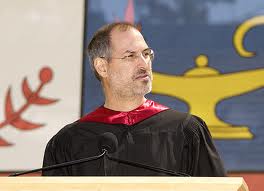
There's been a lot written about Steve Jobs this week - almost like eulogies while he's still alive, although deeply imperilled.  He's certainly been a significant force in society beyond just business.  He came full circle at Stanford when he gave the commencement speech in 2005.  It's worth listening here for his take on life in general.  You've probably heard the value of telling stories as a way of making your point.  Jobs' three stories prove the point.