The latest TED Book Club selections are out. As always, it's an interesting bunch.
 Steven Pinker has given several talks at TED, including his 2007 talk which made a deep impression on me. He argued that, despite today's news overload focused on bad news, the level of violence and wars has actually been declining in the world. You can find that talk here. Apparently the talk sparked further research and analysis and culminated in the publication of a book.
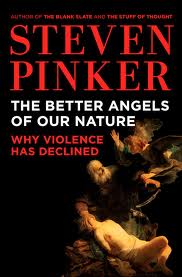
The Better Angels of our Nature elaborates on that theme, arguing that violence between humans is in long term decline. I remember Pinker showed a graph showing the incidence of wars and numbers of deaths in those wars. I imagine I'll find that one in the book when I get around to it.
A friend recently pointed me to a counterargument presented in a TEDx talk by Jonas Gahr Store, the Norwegian foreign minister, which you can view here. (Thanks Scott). Store focuses on a shorter time frame - just since 1946 - and he s argues that violence hasn't really declined overall: the increase in intrastate violence has grown faster than the decline in interstate violence.
 I'm really looking forward to reading Pinker's book, to understand more clearly his proposition and the his evidence to support it, and to compare it with Store's point of view.
 Also in this batch was Michael Shermer's The Believing Brain. Shermer is another TED speaker that I enjoyed. He characterizes himself as a professional skeptic and is the founder of Skeptic Magazine. His 2006 TED talk was hilarious as he mocked various outrageous beliefs held my many people. He did a reprise in 2010, unveiling more hoaxes and gimmicks, but also argued that we have a belief engine in our brains which makes us want to believe. The Believing Brain explores further why we believe the weird things we do. On his web site, Shermer describes the books as "a comprehensive theory on how beliefs are born, formed, nourished, reinforced, challenged, changed, and extinguished." Again, I'm looking forward to reading this book. Maybe it will explain to this puzzled Canadian why so many Americans believe in creationism over evolution!

The last book in the mailing was The Fairy Tales of the Brothers Grimm. This illustrated collection of fairy tales was printed in time for the 200th anniversary of the Brothers Grimm's tales. A quick glance through the book revealed some tales that I was not familiar with. This should be an eminently skimmable book!
For those interested, there are several other posts about TED Book Club Selections:
Also there are a few reviews of books from the book club:
 Steven Pinker has given several talks at TED, including his 2007 talk which made a deep impression on me. He argued that, despite today's news overload focused on bad news, the level of violence and wars has actually been declining in the world. You can find that talk here. Apparently the talk sparked further research and analysis and culminated in the publication of a book.
 The Better Angels of our Nature elaborates on that theme, arguing that violence between humans is in long term decline. I remember Pinker showed a graph showing the incidence of wars and numbers of deaths in those wars. I imagine I'll find that one in the book when I get around to it.
A friend recently pointed me to a counterargument presented in a TEDx talk by Jonas Gahr Store, the Norwegian foreign minister, which you can view here. (Thanks Scott). Store focuses on a shorter time frame - just since 1946 - and he s argues that violence hasn't really declined overall: the increase in intrastate violence has grown faster than the decline in interstate violence.


The last book in the mailing was The Fairy Tales of the Brothers Grimm. This illustrated collection of fairy tales was printed in time for the 200th anniversary of the Brothers Grimm's tales. A quick glance through the book revealed some tales that I was not familiar with. This should be an eminently skimmable book!
For those interested, there are several other posts about TED Book Club Selections:
- November 2011 list
- September 2011 list
- June 2011 list
- February 2011 list
- August 2010 list
- May 2010
- January 2009
- October 2008
Also there are a few reviews of books from the book club:


